Sleep, depression, and functional brain connectivity
McLean Hospital, Harvard Medical School affiliate · Research Intern · Mentor: Dr. Mohammad S. E. Sendi
Using resting-state fMRI, I study how sleep duration and depression symptoms relate to functional connectivity, the coordinated activity between brain regions, in large population and clinical cohorts. I build the MATLAB pipelines for data integration and statistical analysis.
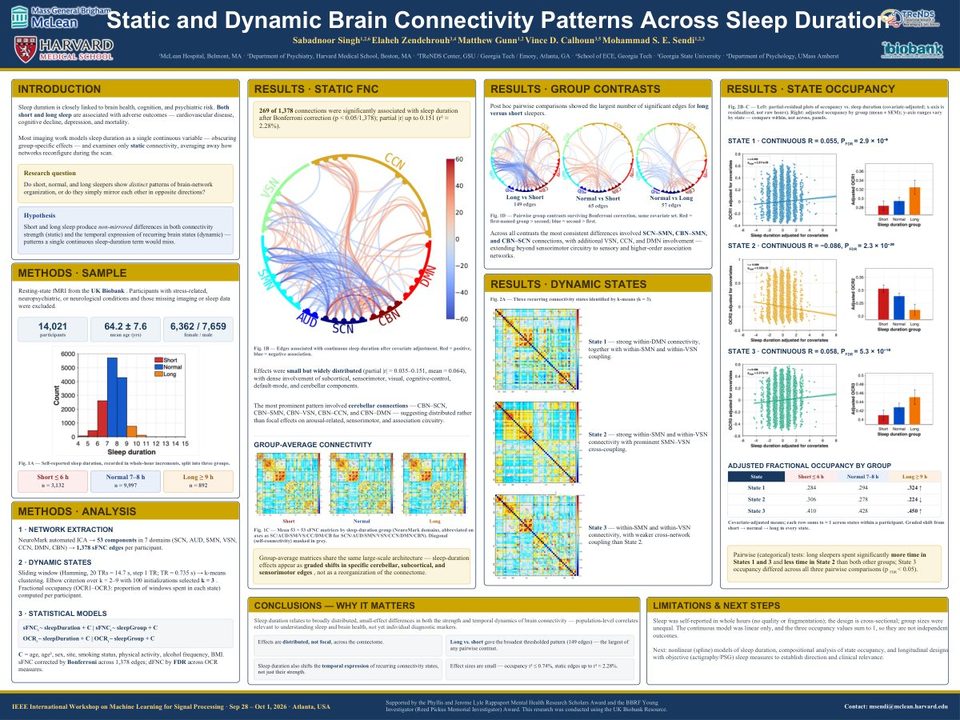
- Sleep and connectivity (first author). In 14,021 UK Biobank participants, identified 269 sleep-associated connections. From short to long sleepers, time spent in one recurring brain state fell from 30.6% to 22.4%, while time in another rose from 41.0% to 45.0%.
- Depression across cohorts. Extended a depression analysis to three cohorts and designed a held-out replication: connections that overlapped in two cohorts were tested in the third, where the convergence was far beyond chance.
- Interpreting differences. Distinguished reduced statistical power from weaker effects in smaller cohorts, checked robustness across model assumptions, and presented recommendations on cohort and depression-measure comparability to my mentor and the principal investigator.
Methods
Sleep duration study
- Participants grouped as short (≤6 h, n = 3,132), normal (7–8 h, n = 9,997), and long (≥9 h, n = 892) sleepers.
- Static connectivity: NeuroMark independent component analysis (53 components, 1,378 connections per participant).
- Dynamic connectivity: sliding-window correlations clustered with k-means into three recurring states. Each participant’s time in each state was the outcome.
- Covariate-adjusted general linear models (age, age², sex, site, smoking, physical activity, alcohol frequency, BMI), with Bonferroni correction for static connections and false-discovery-rate correction for state occupancy.
Depression replication
- Cohorts: UK Biobank (37,458 participants), the Human Connectome Project young-adult sample (833), and a clinical major depressive disorder cohort from China.
- Each cohort was analyzed separately with a comparable pipeline and statistical model rather than pooled.
- Candidate connections were selected in two cohorts, independently of the third, then tested in the held-out cohort.
- Effect sizes and statistical power were compared across cohorts, alongside sensitivity analyses and checks of demographic and depression-measure comparability.